

SAP & RdSAP Consultation response
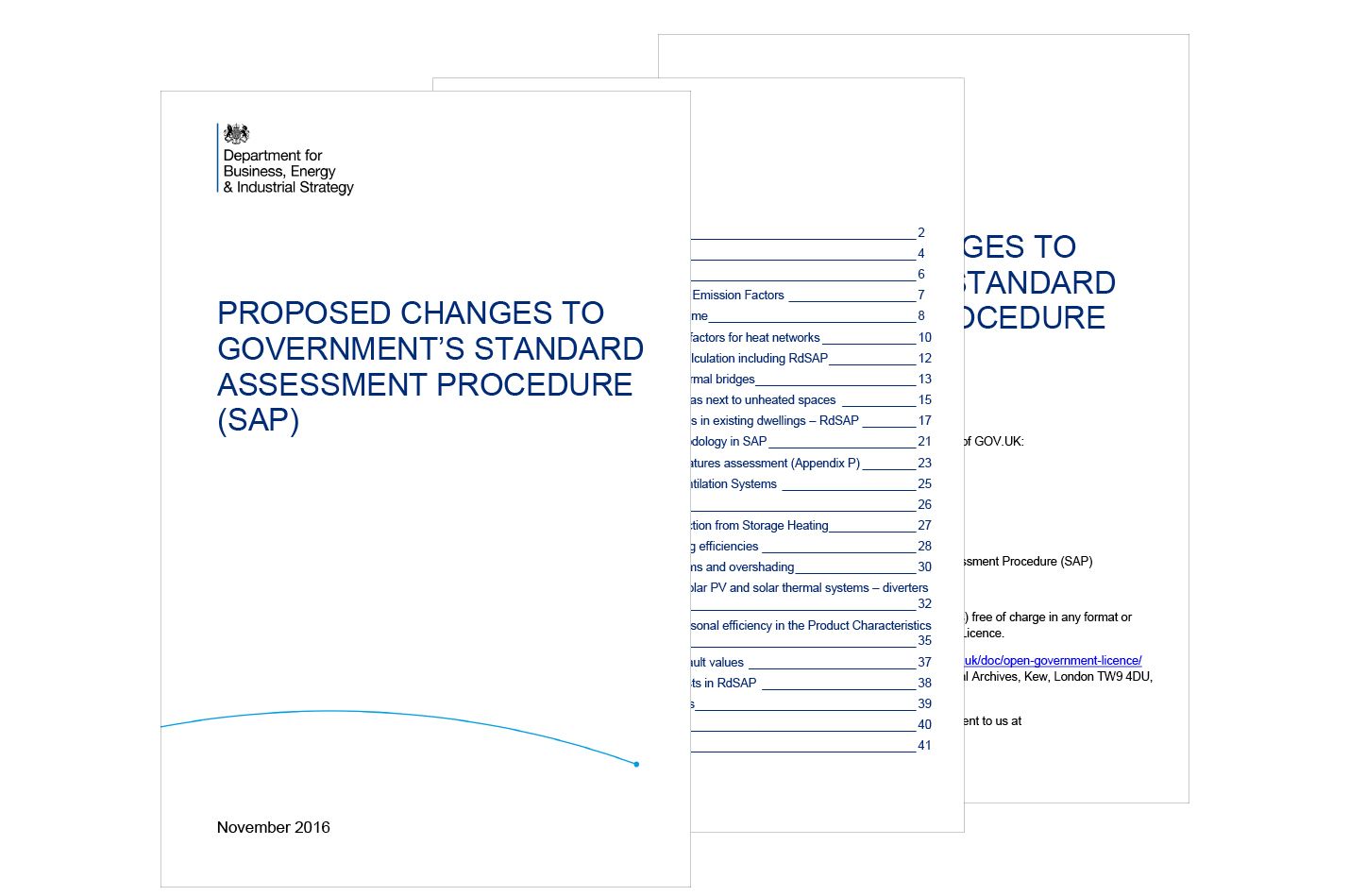
The Department for Business, Innovation & Skills (BEIS) announced in December that there would be a consultation on the methodologies for SAP and RdSAP. We would like to share our thoughts on the 20 questions posed in the consultation and elements of the formal response we have submitted to BEIS on behalf of our members.
The Stroma Certification response has been compiled by Andrew Parkin (Technical Manager), Simon Berry (SAP Scheme Manager) and Grant Susse (DEA Scheme Manager) alongside our management team and technical support staff.
Question 1 - Do you agree with the proposal to use the methodology set out in the technical working paper for calculating carbon emission factors and update the figures?
Overall, we believe the proposed methodology to be logical and will help to achieve some balance between the validity period of the EPC and the period between the current version of SAP and its next release. We have also highlighted potential implications for developments looking to achieve a specific Environmental Impact rating; as well as the way in which the revised emissions factors will affect how developers comply with regional building regulations.
Question 2 – Should we keep the current set of heating patterns set out in SAP or move to using two heating periods every day of the week?
We lent support to the notion of amending the current heating patterns providing that this resulted in more accurate energy performance of dwellings. If a methodology change is undertaken we have recommended publishing a short summary of each version change to improve homeowner understanding.
Question 3 - Do you agree with the proposal to amend default Distribution Loss Factors for Heat Networks?
We have expressed general agreement to this proposal to improve the assessment of heat networks. Whilst this might have a small detrimental impact on EPC ratings it is hoped that installers would then be encouraged to include data in the PCDF. We do have concerns about the evidence requirements for as built assessments and EPCs under the new methodology. Steps need to be taken in order that energy assessors have easy access to the certificate or headed letter required from the network designer and commissioning engineer. Stroma is mindful of any impact that this proposed change would have on RdSAP methodology and calculation, specifically if defaults on heat networks are change in line with SAP, would this result in lower EERs; bearing in mind the legislation surrounding minimum Energy Efficiency Standards.
Question 4 – Do you agree with the proposal to change the way that lighting is calculated in SAP?
We believe that the proposals for lighting calculations are too simplistic and may hinder the efforts of energy assessors when gathering this information. We have therefore proposed a more detailed segregation in RdSAP lighting descriptors. We have also highlighted other concerns around evidence requirements for new build and knowledge of lamp types which might have an impact on assessment accuracy.
Question 5 – Do you agree with the proposal to remove the default values in Table K1, review default values as proposed, and recognise Certified Thermal Details and Products schemes? Do you agree with the proposal in due course to amend the default yvalue to 0.2?
We welcome this attempt to update the SAP EPC calculation and revise the default values. It makes sense to have a centralised database for psi-values which is freely available. The amendment of the default y-value to 0.2 will also close an outstanding loophole affecting the accuracy of the EPC when calculating psi-values.
Question 6 - Do you agree with the proposals to adjust U-values and Ψ-values for elements next to unheated spaces?
We feel that this would result in more accurate results and certificates. We have also requested clarification about whether this proposed change would result in a altering the way a dwelling with an integral garage is assessed within RdSAP.
Question 7 – Do you agree with the proposal to change the default U-values for walls for existing buildings in RdSAP?
We offered general agreement on the condition that the new defaults were robust enough to be applied to all dwellings in the affected age bands, across the various areas of each region, taking into consideration variations of construction methods and materials used.
Question 8 – Do you agree with the proposal to amend the hot water methodology in SAP?
There is more work to do here to ensure water heating requirements are correctly calculated. Whilst it would be beneficial for new build assessments, there needs to be greater consideration over the values required and the method of obtaining them.
There is more work to do here to ensure water heating requirements are correctly calculated. Whilst it would be beneficial for new build assessments, there needs to be greater consideration over the values required and the method of obtaining them.
We agree in principal with gaining greater accuracy in this area but have concerns over the practicalities, particularly in smaller properties.
Question 9 – Do you agree with the proposals to change the questions in the assessment of internal temperature in summer (Appendix P)?
We agree in principal with gaining greater accuracy in this area but have concerns over the practicalities, particularly in smaller properties.
Question 10 – Do you agree with the proposal to amend the treatment of Mechanical Ventilation Systems in SAP?
Again, we agreed with this proposal and have suggested it is linked to the compliance report in order to further assist energy assessors.
Question 11 – Do you agree with the proposal to change the assumed air flow rate for chimneys and flues in SAP?
We agreed with this proposal.
Question 13 – Do you agree with the amendments proposed to solid fuel heating efficiencies?
We accepted the revision of the SAP table values and believe that this will increase the use of the table values amongst energy assessors.
Question 14 – Do you agree with the proposal to amend the procedure for determining overshading of solar PV installations?
Though we agreed with these changes, we did raise the point that assessors could have difficulty finding near obstruction information and other requirements to determine the correct calculation.
Question 15 – Do you agree with the approach to adjust the carbon savings where solar PV electricity is used in the home to heat water or where it is put into battery or other storage? Do you have a view on the correct export tariff for PV electricity exported to the grid? Do you have ideas on how solar thermal space heating, or storage of solar PV or hot water through a battery or other medium can be modelled?
We prefer a conservative approach to on demand/export/space/water heating .The identification of diverters should be straight forward for new build however it could be harder for existing dwellings.
Question 16 – Do you agree with the proposal to provide a series of seasonal efficiencies for boilers on the Product Characteristics Database dependent on the controls they use and the design flow temperature of the system? Do you agree with the proposed change to the Energy Balance Validation method?
Providing a series of seasonal efficiencies for boilers on the PCDF (incorporating the controls and design low temperature of the system) should result in more accurate results and consistency. The current SAP and RdSAP methodologies can already incorporate this PCDF change without any effect on the dataset. We also indicated our agreement to change the Energy Balance Validation method as it brings the other fuel types into line with gas and is also more reflective of the boiler at part load rather than full load, as this is more reflective of the normal operation of most boiler systems in situ.
Question 17 – Do you agree with the proposal to amend the default values for some heat pumps based on evidence from RHPP field trials?
We believe that increasing the current SPF values for systems where sufficient real life analysis has been achieved is a good starting point for improving the accuracy of the SAP and RdSAP derived certificates – we hope that other defaults can also be updated in due course.
Question 18 – Do you have any evidence on the technology costs used in RdSAP?
We have suggested specific installers are consulted on this matter.
Question 19 – Do you have any evidence to update the assumptions that SAP makes about heating controls?
Due to the complexity of this matter we have suggested that a separate consultation is required to progress this area.
Question 20 – Can you provide any evidence on the cost and benefits to business of revisions to SAP independent of changes to any particular set of Buildings Regulations?
We believe there to be an obvious synergy between SAP and BIM in the coming years. SAP outputs will form a key part of the Asset information Model (AIM) that is handed over to the end client on completion of the project, giving the occupier better data to manage their asset (or in this instance home) more efficiently. Assessors will also benefit from accessing a single source of data as part of the CDE (common data environment). This will result in more efficient working practices.
Andy Parkin concluded:
“As one of the largest accreditation bodies of DEA and OCDEA assessors, Stroma Certification has taken the time to respond to the government’s consultation on potential changes to the SAP and RdSAP methodologies.
Stroma is keen for the SAP methodology to become more accurate, and where inaccuracies have been identified or new technologies become common place, then the methodology must change.
Overall, Stroma welcomes the opportunity to provide feedback on this consultation and again suggest that our members do likewise. It is clear to Stroma that where empirical evidence exists to prove that SAP2012 requires improvement (to methodology or default values) then changes should be made. However, increased accuracy should not come at the expense of difficult to follow conventions or time consuming methodology."
Once the consultation has been closed, the government will take time to consider all responses and will then produce a final response. Stroma will make this available to our members at that time. Stroma will also be looking at how the confirmed changes will affect the data, evidence and results of the EPC and the major differences between SAP2012 and SAP2016 methodologies, so that our members can be best placed to work with their clients going forwards.
If you are interesting in viewing and/or responding to this key consultation, you can do so via this website.
The Stroma Group






©Stroma Certification Ltd 2026
*Calls cost 7p per minute plus your phone company’s network access charge or call 01977 665420.